Monday, May 26, 2014

A Little Bit About Oman

When I started telling some people I was moving to Oman, the answer I got a couple of times was, "Omaha? Nebraska? Why on earth are you moving there?" Since this part of the world isn't exactly familiar for most Americans, I figured I'd do a little briefing here on the country and its culture (cribbed heavily from Wikipedia and useful maps/pictures I could find online - none of the pictures are mine, since I try to avoid taking pictures of people here out of politeness).

Location


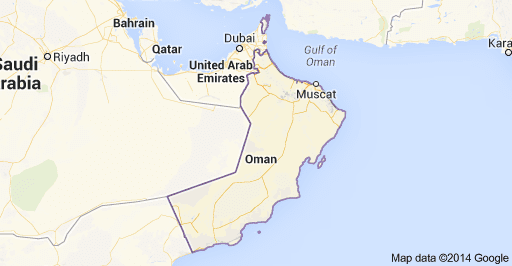
For starters, Oman is located on the Arabian Peninsula and bordered by Yemen, Saudi Arabia and the United Arab Emirates.  Yemen is too dangerous to visit right now and Saudi Arabia is off limits for me, though we can drive about 4-5 hours up to the UAE to visit Abu Dhabi and Dubai.

As you can imagine, it's hot as balls in the summertime (this week we're 110-115 degrees Fahrenheit), though the south of the country does get rain and breezes in the summer that make it unique for Arabia.

A Little History

Oman is a Muslim country, though most Omanis are not Sunni or Shi'a, but rather Ibadi Muslims and the national language is Arabic.  Unlike its Arabian neighbors, Oman was a major seafaring power from the 17th century and the Omani Empire extended down the coast of Africa and into parts of southern Iran.  This meant that during a time when most people living in Arabia were hunkered down in their tents herding their camels, Omanis were out conquering different cultures and peoples.  Not only did this expose Omanis to other cultures, but it also helped shaped Omani culture -- it's easy to see African elements in the national dress here as well as tell which Omanis originally came from East Africa.  It also helped keep Oman more open and progressive than some of its neighboring countries (ahem, Saudi Arabia). 

Also, interestingly enough, Oman was never entirely controlled by a foreign power and Oman has been self-governing since the 1700s, which is a marked contrast to most of the rest of the Middle East.


Economy

Oman does have oil and gas (which is why I'm here), though not anywhere near the amount of some of its neighboring countries.  Oman has lagged behind its neighbors (with the exception of Yemen) in development and wealth, partially due to its previous Sultan.  Sultan Qaboos deposed his father in 1970, but prior to that time his father really closed off the country and many of my colleagues here told me how bad things were here prior to 1970.  In fact, many Omanis lived abroad until Sultan Qaboos took over and opened the country up, which is partially why he's so well loved by Omanis.

Despite its slow start, Oman has really developed over the past 40 years and has tried to diversify its economy so as not to be solely reliant upon oil and gas.  Muscat is very cosmopolitan and feels like a major city, though it's important to remember that not so long ago many Omanis were living in villages and did not have much exposure to the West or "modern" conveniences.  You occasionally get a glimpse of that when you talk to people or when you realize that many of my coworkers go home to their villages on weekends.

Expats make up almost 50% of the population here, and so in recent years there has really been a push for Omanization, which really means training the local populace to do the jobs that expats have done.  While I may not always agree with the measures taken to achieve Omanization, I think it's a great effort to integrate Omanis into the workforce so that they don't follow in the steps of some of their neighbors, like the Emiratis, many of whom don't work and maintain their lifestyles from oil revenues.  There are measures in place to force companies to hire locals and purchase locally made goods and ever-changing visa regulations affecting expats.  There are some expats who feel as though our presence isn't welcome based on these regulations, but in reality Omanis are not yet in a position to fill all the roles that expats currently do. (Due to recent changes in visa regulations, there is a huge debate occurring in Oman right now regarding Omanization.  I wanted to give a simple overview of the life here without getting into the weeds on the issues).

Finally, most Omanis speak English very well.  While I'd like to learn Arabic, many Omanis I work with primarily speak English since they were schooled in the West (even with their families) and others are excited to speak in English to strengthen their language skills.  And all of the signs here are in both Arabic and English, making driving around fairly easy.

National Dress

Omani men typically wear a dishdasha, which is a collarless, ankle-length gown that is typically white (although they do come in a variety of colors and also sometimes have colored stitching around the neck and wrists) and sandals on their feet.  On their heads they either wear a mussar, which looks like a wool turban (see the second picture below), or a kummah, which is a stitched cap (pictured below).  For Omanis who work in government, it is required that they wear the mussar, though in my office most tend to wear the kummah


I'll admit, it takes a little getting used seeing guys in the office wearing sandals and flip flops, though I'm always jealous when we're outside in the blazing sun and the dishdasha seem so much more comfortable.  I have no idea how they keep them so white, though I did finally ask someone what they wear under them (fabric wrapped around their waists like a towel). 

Unlike in some of the other Arab countries, the men here can really personalize what they wear since the dishdasha come in a variety of colors and there's even more opportunity for personalization when it comes to the colored stitching or the various hat options.  For formal occasions, men will add a dagger at their waist. 

Omani women typically wear the abaya, which is a black, floor-length robe with a scarf covering their hair and necks.  Traditional Omani dress is much more colorful and is apparently still worn at some functions, but the abaya gained popularity probably due to its ease and the fact that the women in the neighboring countries wear abayas.  (Note: I haven't actually seen Omani women's traditional dress in person yet, though I'm eagerly awaiting the opportunity to attend an event where I can see traditional dress!)


What About Expat Dress?

As an expat we are not required to wear abayas or dishdashas (actually, I think it would be quite rude if we did attempt to wear the local dress), though we are expected to dress modestly.  For both men and women, this means covering shoulders and knees.  Other than ditching my tank tops and shorts, I dress pretty closely to what I would have back in the US, particularly in the office.  I find that on weekends it's a little bit of a struggle to dress appropriately to run errands (I have one pair of linen pants that I've been wearing the hell out of) because it's just too hot to contemplate most pairs of pants.  So my weekend attire is pretty much linen pants/maxi skirt and a lightweight t-shirt.  And lots of sandals since wearing closed shoes is pretty miserable and sweaty.

Beaches are a little more of an issue.  It would be inappropriate to wear a Western bathing suit on most public beaches, so many expats tend to become members at some of the hotels here in order to use their private beaches.  I have yet to go to the beach since I have my own pool, though considering how clear and blue the Indian Ocean is, I know I'll need to find a beach to go to sooner or later.


I'm still learning about all things Oman, but let me know if you have questions.  Even if I don't know the answer I'm happy to ask, since that's how I learn all sorts of useful information (like what men wear under their dishdashas).  And my coworkers are used to me asking all sorts of weird questions...

A Month In

Saturday marked my one month anniversary of being here and I have to say I truly love it here.  The scenery, the people, the more relaxed way of life...all of it. 

A number of you have asked about whether certain things are hard or if there are aspects I don't like.  Well, there are certainly adjustments to be made.  For example, I still don't have internet at my house because there is a months-long waiting list to have it installed.  On Saturday I bought patio furniture, which wound up being a two hour ordeal.  Despite that I bought the floor model that displayed the prices, it took the [major] store almost an hour to find a barcode to go with the chairs.  Shaving cream for women turned out to be the most difficult thing to find over here and I've already started receiving care packages from home with some essentials that I can't buy here (like ice cube trays).

So yeah, there are certainly things that are more difficult here and the lifestyle could test the patience of a zen master.  But I've also adapted to this life quite well and am enjoying the slower pace of...well, of everything. 

I've also met a lot of interesting people, both Omanis and expats.  I always assumed I'd like expats because many, like me, are nomads at heart and avid travelers and experiencers of life.  Many of the people that I've met are well-traveled, up for anything and open to living in different places under varying circumstances.  I've tried to stay away from the expats that hate it here -- they're easy to spot, tend to be Americans and don't seem to have much interest in exploring the country or the area.  Which is such a shame because, though I haven't really gotten out of Muscat yet, there is so much in this country to do and experience.

Saturday, May 10, 2014

Off to the Souk

On my first visit to Muscat in February I had briefly stopped by the port area and seen some of the spectacular scenery of old forts and a brief glimpse into the Muttrah souk, the largest souk in Muscat.  Souks are the old Arab markets, though the Muttrah souk is enclosed and you follow labyrinthine hallways to all the different areas of the souk to buy things like frankincense, rugs, jewelry and handicrafts. 


Yesterday a coworker and I set out to the souk for a little shopping.  I knew we'd be ripped off since we look like tourists.  While I'm generally okay being ripped off in markets when I travel, I don't want to be ripped off in my home, though unless I go there with an Omani it will keep happening.  Putting aside my annoyance at paying extra, I bought some Omani jewelry and some Omani-style rugs for my bare floors.  The rug guy kept trying to explain the difference to me between Omani rugs and Arab rugs, but the best I could tell is that the Omani rugs are more geometric-based designs.  And definitely colorful.

After shopping we had a lovely dinner at Karjeen, which is an Omani outdoor restaurant in a garden.  The scenery was gorgeous and this was the first time I'd gotten to try Omani food.  I tried shuwa, which is a traditional dish of a meat (generally camel, lamb or goat...I think I had goat) that is slowly grilled in a pit overnight and then served over rice.  I wasn't actually all that impressed with the shuwa - it had a lot of little bones that were hard to pick out, was a bit dry and I've never been a fan of plain white rice.  My stomach also didn't appreciate some of the spices that the meat was cooked in, but at least I can say I tried it!

Wednesday, May 7, 2014

Adventures at the DMV

After all the trials and tribulations of getting a visa, it was time for me to get the rest of the official documents, including my resident’s card and an Omani driver’s license.  Our HR provides us with a public relations officer (PRO) who helps assist us in getting through all the government channels, so two days ago my PRO picked me up and shepherded me through a variety of government offices.  After about our third stop he looked at me and said “You’re not like the other expats and definitely not like the normal lawyers.  You’re just so….cool!”  Apparently all of the lines and government processes (not to mention the waiting areas filled with hordes of workers from the Indian subcontinent) stress out the average expat, whereas I was just happy to be out of the office for a day (and not in Dubai).

We hit our first snag at the DMV.  When I was here in February I had to go to the US Embassy to get a document signed that I’d been driving for more than a year since my Texas driver’s license was less than a year old.  When we showed up at the DMV, US Embassy form in hand, we were told that no one there had ever seen the form before and, since apparently they couldn’t read it, we would have to return the following morning to see a manager.
So yesterday my PRO picked me up again and off we went to the DMV.  The “manager” flipped my license over and saw in tiny letters “REV 01/05/07” and seemed to think this date had something to do with me.  She seemed so confident I didn’t want to point out that that date was the date the license format was revised and was on everyone’s Texas license.  But then she passed off my paperwork to a man who started grilling me on that date.  “So what did you do in Texas in 2007?” he asked.  “Well, that was the date that I originally moved to Texas.  Then I left and moved to California and had to get a new license,” I responded, figuring that trying to explain what that date really meant would be too complicated (and I really did move to Texas the first time in 2007).  He asked me that question in a number of different ways and I finally turned to my PRO and asked if he could explain that in the US, every time you move to a different state you have to get a new license.

A flurry of Arabic followed that got a little heated as the minutes passed, with the DMV officer angrily pointing at my license and then at me.  Though he finally signed my paperwork, my PRO told me that he was convinced my license was a fake.  Seriously?!?  US passports are incredibly hard to fake and I had a document signed by the US Embassy indicating I’d had a license for over a decade, but this guy who thought that REV 01/05/07 related to me thought he knew better?
So then I was asked my blood type, which apparently is required on drivers’ licenses.  I turned to my PRO and said “No clue – what’s the most common blood type?  Let’s just put that.”  He looked at me in shock, mouth wide open, and said “Are you sure you’re American?  You’re really going to lie on a document?”  I shrugged and said, “There’s no way I’m going to a doctor here to get tested and I certainly don’t want to have to come back here, so let’s just put something down and get the license.  If I have a car accident here and need a blood transfusion, I’ve got bigger problems.”  He let out a loud laugh and again exclaimed how different I was from the normal expat. (Turns out I am O+, which is what we put down, so no need for me to try to learn in Arabic how to say I’m a different blood type than what’s on my license.)

After I finally had my license in hand and we got back in the car, I asked about organ donation.  He had no idea what I was talking about, so I said that in the US we put on our licenses whether we are willing to donate organs in case we’re dying.  He was absolutely appalled at the idea – you mean you take parts out of dead bodies and give them to other people?!?!  How barbaric!  So I asked what you did over here if you needed a new kidney or lung.  He looked at me like I was an absolute idiot and said “We have Indians for that.  And they’re more than happy to give up parts while they’re still alive.”

The Indian Head Bob

In the Middle East most workers are from the Indian subcontinent and there have been quite a few times where I’ve felt like I was on the streets of Delhi rather than Muscat.  Or that I’d be better off learning Hindi rather than Arabic.  And while I hate to make racial or ethnic generalizations, some of the Indian cultural mannerisms drive me far crazier than the Arab ones.  These are the two big ones I’ve come to cringe at thus far:

1. The Indian Head Bob
I was trying to explain to my pool guy that he couldn’t let the cat out.  He began bobbing his head in all directions (up and down, side to side, even a little diagonal action in there) that seemed to simultaneously indicate “yes/no/maybe/I have no idea what you just said”.  It did not inspire much confidence and I’m fairly certain that he’s going to leave the door wide open and let the cat out (assuming he ever actually comes to clean the pool). 

2. Yes, yes, yes, yes!
There are many cultures where it is unacceptable to tell someone no, and so you always say “yes” even if you know you can’t accomplish whatever you’ve agreed to.  But what I’ve learned in my short time here is that the more yeses you hear, the less likely something will actually happen.  An example:

Me: “So you’ll be by the house today at 4:30 to fix the leak?”
Indian Repairman: “Yes yes yes!”

Me: “So in one hour you will be at my house?”
Indian Repairman: “Yes yes yes yes!”
Me [mentally]: Oh crap, that’s four yeses.  There’s no way he’s coming…
Needless to say, no one ever showed up to fix my leaks (or anything else, for that matter).

The True Meaning of Insha' Allah

A phrase you’ll hear very often in the Middle East is “Insha’ Allah”, which means “God willing”.  Many Muslims end most sentences with it, like “I’ll see you tomorrow, insha’ Allah”.  To the devout person, this is a frequent acknowledgment that everything in life only happens through Allah’s will.  However, more often than not, it can sometimes be an excuse to not take responsibility for anything (or to never meet deadlines) that frustrates most expats to no end. 

“Hi, when will my internet be installed?”
“By the end of the week, insha’ Allah.”
1 week later

“I was still wondering when my internet might be installed.”
“Soon, insha’ Allah.”
I was prepared for this attitude towards deadlines and commitments and I’m doing my best to adopt what I call an “insha’ Allah approach to life”.  Deadlines really don’t mean anything and so the fact that I’ve been here almost two weeks and still don’t have internet and still can’t get the basic maintenance items in my house fixed is something to shrug over rather than get upset over.  I suspect I’ll find myself shrugging a lot here.
The other thing that’s really helping me to maintain my insha’ Allah attitude is watching other expats.  There are some that truly seem to hate it here, and if you get them started on life here you’ll get a constant stream of complaints about how nothing ever gets done and no one has any work ethic.  On the other hand, there are expats who seem truly happy to be here and seem to be embracing the lifestyle and the adventure of it all.  And they also shrug a lot. 

So I think if I want to love it here and not become bitter, I’ll have to learn to be less American in my temperament and more accepting that things will move on their own timeline here.  And at the end of the day, if my house floods (as it has already done) and no one fixes it, it will eventually evaporate in the desert heat.  So next time it rains, maybe it won’t flood, insha’ Allah.

Monday, May 5, 2014

A Dubai Debacle

Since I moved to Oman without my work visa, once my work visa was ready I needed to take a quick trip out of country so that when I reentered I could get my resident visa.  I figured a quick day trip to Dubai would be great to do a little Ikea shopping, so I left for Dubai with nothing more than my purse.

After a couple of hours in Dubai I was done with all the shopping I needed to do and was reminded again why I hate Dubai -- it's really just one overpriced mall after another and there's only so much shopping I can do with inflated prices.  So after a nice lunch I gave up and went to see The Amazing Spider Man, figuring that would at least waste a few hours until my flight. 

But during the movie my work phone kept ringing and when I finally stepped out to take the call, I was informed that my visa hadn't come through and I'd have to spend the night in Dubai.  Except I didn't have any clothes, toiletries, contacts or anything else.  So after the movie I ran around the giant malls trying to find the bare essentials for a night in Dubai and I headed off to my hotel in a cranky and foul mood, muttering to myself about how much I hated Dubai. 

I do have to admit that my second day in Dubai was much more enjoyable and I actually found some of the essentials I had missed on my first day.  And spending some time at Sephora putting on make up made me feel a bit less frumpy in my day old clothes. 

When we landed in Muscat I was shocked to see that it was drizzling outside and, based on the puddles on the ground, I had to assume it had rained all day, which is apparently quite rare here in the summer.  By the time I arrived home the rain had stopped, though I had quite the surprise inside...my entire entryway, kitchen and dining area had about an inch of standing rainwater!

 
Workmen were supposed to come by to figure out where the leak came from.  No surprise, but they never showed up, so Zim did his best to mop up the puddle.