Wednesday, September 17, 2014

Land of the Rising Sun

I'm a little late in writing about it, but I spent the first ten days of the month traveling around Japan:


It's a bit weird that it took me so long to get around to visiting Japan, but I have to say it was never high on my destination list.  Crazy, I know, but here's why:

1) Japanese Tourists. I hate traveling to places where there are hordes of Japanese tourists, snapping photos of everything while they grin and make the "peace" symbol. Two years ago I visited Auschwitz and I was practically in a homicidal rage following around a pack of Japanese tourists who gleefully took photos of themselves (and the ubiquitous peace symbol) in front of everything.  All while talking (and giggling) loudly on their cell phones. Anyway, I just figured that if Japanese tourists were so irritating, I wouldn't want to be surrounded by a country full of, well, Japanese people.

What do all major tourist destinations have in common? Japanese tourists and their cameras.

Seriously, just google images of "Japanese tourists", it's so worth it


Scooby (or Godzilla, as I'm
sure the locals thought of him)
2) The first year I lived in Los Angeles I lived in the part of LA dubbed "Little Tokyo". It was a cute part of town that had a ton of sushi restaurants and where the street signs were primarily in Japanese rather than English. The cuteness wore off pretty quickly as I was kept up late at night by the favorite pastime in the local bars - karaoke (or, as I like to pronounce after living there, "karra-oh-kay") and the smell of tempura-fried food. My fondest memories of Little Tokyo were walking my 90 pound wolf dog while the tiny locals ran in fear - I dubbed them my Godzilla moments.
Yeah, kinda like that.


3) I figured I'd hate Tokyo. I just assumed Tokyo would be crowded and hectic with lots of neon signs and anime kids and annoying girls trying to pull off the Lolita look. And while saying I don't want to go to Japan because I'd hate Tokyo is like someone saying they don't want to visit the US because they'd hate LA, it still felt like a relevant reason to not want to go.

4) Japanese culture is very "other". In college I minored in anthropology and loved studying other cultures (part of why I love to travel and see different cultures firsthand). In one of my classes we did a segment on Japanese culture and, of all the cultures I studied, Japanese culture was the hardest one for us to understand and accept. According to that long-ago class, it was still socially acceptable to commit suicide if one shamed their family - and "shame" could be as simple as getting a bad grade in class or losing a job. I suspect the recent recession has lessened that somewhat, but that mentality still felt so foreign to me. I also learned more about Japanese culture while studying World War II - one of the reasons the American military felt that the nuclear bombs were so critical is because the Japanese did not believe in surrender (see Part 2 of this post for more on that).

All of that being said, I did really want to learn more about Shinto (the Japanese national religion) and to see rural Japan. I figured the temples and shrines in the mountains must be gorgeous and well worth whatever frustrations might be caused by Tokyo. Plus, I couldn't think of anywhere else I really wanted to go for the first two weeks of September.

The first main stop of the trip was Koyasan, which is the center of Buddhism in Japan. Shingon Esoteric Buddhism, to be exact. Koyasan is on Mount Koya, so to get there from Osaka we took a bullet train and then a cable car up the mountain. Koyasan is a quaint little town filled with monasteries and temples and loads of monks. We stayed at the Ekoin monastery, where we slept on the floor, ate vegetarian food on the floor (lots of mushy soy products) and learned a little bit about Shingon Esoteric Buddhism. Shingon Esoteric Buddhism involves a lot of meditation and chanting and practitioners believe that the founder of this sect of Buddhism is still meditating in a temple in Koyasan.

The first afternoon in Koyasan, after viewing what felt like endless temples, we attended a meditation class with the monks. Gotta say, meditation isn't really my thing since I spent the whole thirty minutes thinking of how much my legs/hips/ass hurt from sitting cross-legged on the floor. And then dinner was also on the floor...

Our vegetarian dinner at the monastery. My hips and legs hurt just remembering having to eat on the floor.
Our vegetarian dinner. I ate a little of everything, though we were all hungry again about an hour later.


After dinner one of the monks took us on a tour of the local cemetery, which was enormous and included both Shinto and Buddhist elements. What is interesting is that most people in Japan are both Shinto and Buddhist, since both are polytheistic religions and pretty accepting of other paths to enlightenment/heaven. My favorite part of the cemetery was the monk explaining some of the grave markings - for example, many had a depiction of the moon in one of its phases. The idea is that, like the moon, humans also have different phases. Some days we're happy, some days we're sad and so on, and it's important to remember that we will wax and wane just like the moon.
 
The following morning I woke up at the crack of dawn to view the monks' morning ritual and fire ritual. Because none of the monks spoke English, I actually have no idea what the rituals were for (though I'm assuming the fire ritual was for cleansing and purification). All in all, I wish I'd gotten to spend a little more time learning about Shingon Esoteric Buddhism. I had so many questions for the monk (How young were you when you became a monk? Was it your choice or your parents' choice? How did you learn English?), but there were just too many people around for me to hog his attention.
 
Apart from the weird food and interesting accommodations, we also got to try a traditional Japanese onsen, or bath. (Remind me to tell you guys later about my experiences in public bath houses.) Ekoin was helpful enough to provide us some directions on how to use the onsen, since it's a bit overwhelming for us prudish Westerners.


I sort of thought that the people sitting on the tiny stools was an exaggeration. Oh no, you definitely squat on tiny stools in front of mirrors. Awkward!

The onsen in our monastery. You bathe while squatting on the tiny stools to the right in front of the mirrors and then get in the massive shared tub to the left.
While awkwardly trying to figure out what to do and how to bathe myself while seated and in a crowded room of women, I was lucky enough to sit next to a brazen Aussie woman. When I looked befuddled, she turned to me and said, "Don't forget to wash your bum!

Well, this turned into an epically long post, so stay tuned for Part 2!

Monday, September 15, 2014

The First Bout of Homesickness

So I got home from Japan last Wednesday morning and I thought I had the perfect plan - spend a couple of days resting and relaxing, catching up on tv and posting pictures before returning to work yesterday. And while the plan worked perfectly for a few hours on Wednesday, pretty much nothing else went according to plan.

A few weeks ago I noticed black mold growing on my patio and inching ever closer to my living room. I had my company's maintenance people come out and they discovered that the pool room (which is directly below my moldy patio) had water literally dripping from the walls due to lack of ventilation. Oh, and lots of big electrical panels were also located in the soaking wet room. So for the past few weeks, I've been trying to get someone out to the house to fix the mold and figure out how to ventilate the pool room. Someone finally told me that maintenance would be out Thursday morning between 9-10 am to address the mold. While maintenance wasn't exactly "rest and relaxation", at least I didn't have to take time off work to meet them at the house.

So Wednesday evening my internet and phone stopped working. Internet is my lifeline to the world - it's how I call home (Skype) and how I watch American TV. So without internet, I just decided to read a book and go to bed at about 8:30 Wednesday night (also good for the jet lag). Thursday morning I immediately notified maintenance that my internet was out and sat and waited for maintenance to come. And waited. By 11 I started sending emails to see if the maintenance crew was still coming and, if so, when. And waited some more. Around 2 pm the internet guys showed up and said they couldn't fix the problem and that we'd need Omantel to come out. Problem is it took Omantel 6 weeks to show up when I first moved here, so that news was pretty depressing.

No one ever showed up to deal with the mold or even let me know that no one was coming, so I sat around the house all day Thursday waiting. With no internet, tv or phones.

Then, Thursday evening I noticed that the water coming out of the sinks was only a trickle. I thought it was weird but didn't think much of it until I tried to shower on Friday and couldn't because only a trickle was coming out of all of my faucets. I called maintenance again on Friday and when they showed up Saturday they said my water pump was broken. No ETA on when it would be fixed and no sympathy for the fact that I couldn't shower. When I tried to impress upon the maintenance guy how much I needed my shower to work he looked at me and said "Get a bucket."

So by Saturday I was cranky and, for the first time, homesick. Nothing was working in my house, I wanted a shower and to watch tv or call home or any of the other things I'd planned to do with my four days off after Japan. And I was frustrated that nothing was getting fixed and that the best I could learn is that things would be fixed soon, inshallahAnd we all know what that means.

Yesterday I spent most of the day bitching to HR and at the house with maintenance showing them everything that's falling apart in my house (which was apparently constructed using chewing gum and duct tape). Apparently the water pump will be fixed today, but I'm not holding my breath. No clue when the internet will be fixed. But at least HR is on it now and if things don't get fixed then maybe I'll get to move to a different house that would hopefully have somewhat less maintenance issues (although apparently the quality of construction over here is so poor that almost all of the houses have mold issues, not to mention the myriad of other things wrong). I also have the option of staying at a hotel until the water is fixed, but I hate to leave my cat at the house alone.

But, in the meantime, the homesickness has hung around. I don't miss Houston per se, I miss the ease and efficiency of living in the US. If my internet went out Wednesday night back home it would have been fixed by Thursday. Same with the water. Or at least you'd get reasonable ETAs from vendors rather than hearing inshallah.

I think I'm just cranky and am really looking forward to my visit back to Houston this weekend. I'm only going for a week (Friday to Friday), but hopefully that's enough time to rejuvenate me. Or at least drink as much Diet Coke as humanly possible in seven days.

* Don't worry, I haven't been stinky and unwashed for the last four days. I have a trickle of water that comes out of the spigot in the shower, which is about two feet above the ground. While it's humiliating and uncomfortable, I have figured out how to bathe myself while squatting/sitting on the floor of my shower. Washing my hair is a bitch and a half, so I'm really stretching the number of days I can go between hair washings, but at least I'm mostly presentable.

Sunday, August 31, 2014

The Convenience Factor

An Omani colleague asked me last week whether I thought living in the US or Oman was more convenient. I paused long enough that he started laughing and said, "Seriously? I thought for sure you would have said the US!" But it's not actually that easy of a determination. 

The main reason for my lengthy pause is the sheer fact that I have a maid here who cooks all my meals, cleans my house and does all of my laundry. And for someone who is notoriously bad at feeding myself, having someone cook for me is pretty epic. And if I had small children, I'm pretty sure this would be a much more convenient life by having a live-in maid who would take care of the kids and everything else.

That being said, almost everything else is so much more difficult here. I have dreams about Target and I'm pretty sure when I go back to the US in a few weeks that angels will start singing when I walk into Target and drop to my knees in appreciation of all its wonders. Seriously though, pretty much the only stores in Oman that have a variety of products are grocery stores and their selection is limited. For example, given the amount I travel I really need to find travel size toiletries (shampoo, conditioner, etc.). I finally gave up on this quest and am just waiting until I go back to the US to stock up because those things simply don't exist over here. Hair products are another incredibly difficult thing to find over here because the grocery stores carry only weird stuff like hair olive oil.

And there's no Home Depot or Lowe's here, so imagine how hard basic things are like getting spare keys made or finding light bulbs in special sizes. Really, anytime I need to buy something that isn't a standard food product (and non-standard food items would include things like sour cream, which took me three different grocery stores to find) I debate whether it's just easier to ship it from the US and wait three weeks and pay customs on it.

I'm currently trying to find a full-length mirror, since I'm tired of standing on my bed every time I want to see the lower half of my body. I've exhausted the grocery stores, so my next option is to find a furniture store, which sounds like so much more of a hassle (and an expense) than should be needed to find a flimsy full-length mirror that I can prop against the wall.

And on that note, I'm off to Japan for 10 days tonight! It'll be a whirlwind trip through the country but it should be a good glimpse into the country and let me know if I ever need to go back and spend additional time there. Stay tuned for Japan stuff in about a week and a half!

Thursday, August 21, 2014

Piercing the Veil

As conflicts in the Middle East have heated up lately, some of my friends' social media posts have commented on what they perceive to be negative Muslim cultural standards, particularly the injustice to women forced to veil themselves.  And while I can't speak to what women might face in other parts of the world (particularly Saudi Arabia, Afghanistan and Yemen), I can at least hopefully dispel those allegations with regard to the rest of the GCC countries, notably the UAE and Oman. 

So first off, the Qur'an (the Muslim bible) requires both men and women to dress conservatively:

"Say to the believing men that they should lower their gaze and guard their modesty: that will make for greater purity for them...And say that the believing women that they should lower their gaze and guard their modesty that they should not display their beauty and ornaments except what (must ordinarily) appear thereof; that they should draw their veils over their bosoms and not display their beauty except to their husbands, their fathers, [long recitation of other male family members], or their women...or small children who have no sense of the shame of sex..."
— Sura 24 (An-Nur), ayat 30-31, Qur'an
 
"O Prophet! Tell thy wives and thy daughters and the women of the believers to draw their cloaks close round them. That will be better, so that they may be recognized and not harassed."
—Sura 33 (Al-Ahzab), ayah 59, Qur'an

Requiring modesty of dress is not unusual to Islam - both Judaism and Christianity require it, though it is often only the most religious who strictly adhere to modest dress (check out the way Orthodox Jews dress for more evidence).  There is also no requirement in the Qur'an requiring women to veil their faces and what "modesty" means is up for interpretation.  So how Muslim women in Afghanistan wound up covering their faces and wearing a burqa has more to do with ideological and political reasons rather than purely religious reasons.


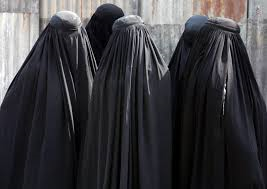
Examples of burqas
To be fair, I don't know a single person who wears a burqa and I rarely even meet anyone in Oman who wears a burqa.  I'd love to meet a burqa-wearer and be comfortable enough with them to ask why they do it and whether they find it demeaning or difficult to perform daily tasks in, but I'm not sure that's going to happen anytime soon (side note: I once sat next to a woman on a plane who wore a sheer veil over her face and every time she needed to see something clearly (like her plane ticket), she had to lift the veil up slightly and place the plane ticket under the veil so she could read it.  It seemed like a lot of extra work and a total pain in the ass). 

So what do most women in GCC countries wear (excluding Saudi Arabia)?  Most women wear an abaya and hijab.  The abaya is a loose-fitting robe (generally black, though in Southeast Asia they were very colorful) that is worn over normal clothing and the hijab is the head scarf that covers everything except the face.

Abaya and hijab

While it may seem like a boring outfit, the opportunities for customization are endless and some abayajabs (my new word I came up with so I don't have to keep writing abaya and hijab) cost a fortune.  Earlier this week I saw what can only be described as a goth abayajab - it had chains and spikes coming out of the shoulders!  Below are some examples of the wide variety of abayajabs available for purchase:


For more options, check out this site and this one or just Google images for "abaya and hijab"
So while the customization of the abayajabs might be interesting and even fashionable, none of the above makes me want to trade in my normal wardrobe in exchange for a long-sleeved robe and a headscarf.  But then I think about this - my normal morning routine for work consists of washing my hair, blow drying my hair, finding an outfit that matches and that hasn't been worn recently and then, throughout the day, adjusting my outfit (trying to figure out how to get my skirt to look less wrinkly, maybe adjusting a waistband after eating too big of a lunch, buttoning and unbuttoning (and belting and unbelting) every time I go to the bathroom, etc.).  Meanwhile, my coworkers get to grab an abayajab, throw it on over comfy house clothes (usually yoga pants and a tank top) and put their hair in an unwashed ponytail.  I'll admit -- there's definitely days where I'm jealous that I can't wear an abayajab to work.

The other thing to consider is the whole reason behind the abayajab - dressing modestly.  I can't count the number of times when talking to a guy that I've wanted to snap my fingers and say "Hey buddy, my eyes are up here."  Or how many of my girlfriends have complained over the years that guys never look at a girl's face, only at her body.  Not to mention the gazillions of dollars we spend each year on our obsession with perfect bodies - plastic surgery, gym memberships, fad diets, etc.  This isn't to say these issues don't exist over here, they're just not as noticeable because a woman's body isn't constantly on display.  So while I don't (and will never) wear an abayajab, the more modest style of dress is nice over here and it's certainly more comfortable (this shouldn't come as a surprise to many of you, but tight and revealing clothes are generally not comfortable). 

I've asked some of my Omani friends how they feel about wearing the abayajab and, for the most part, they don't mind it.  For them, it's a cultural uniform -- just like a lawyer might have to wear a suit to work, they wear the abayajab to work.  If I might wear jeans and a t-shirt on a weekend, they wear an abayajab (though generally fancier/more embellished ones than they'd wear to work).  And when many of them travel outside of the GCC or to Dubai, they put on "normal" clothes (though often still with a hijab).  One of my Omani colleagues dresses completely Western, except she wears a hijab to work and she only started doing that because it saves her styling time in the morning and because some of the catty women at work were giving her a hard time about not wearing one.  I asked her if she ever wears an abaya and she said she does fairly often when she doesn't want to attract male attention, particularly at busy places like malls. 

I'd say that most of the women in the GCC don't see the abayajab as a demeaning method of keeping them subservient to men (as many Westerners perceive it), but rather as a way of diverting unwanted attention (hell, I even wore a hijab a long time ago in Morocco to try to dissuade some of the men from approaching/grabbing me).  As Sura 33 of the Qur'an states, the goal of modesty is to avoid harassment, not to try to demean women. 

Now, all of that being said, I personally think the abayajab can make it difficult to garner respect in a professional environment.  I'm a lawyer and in order to be a good lawyer sometimes I have to give people advice they don't want to hear.  Sometimes I have to a bitch and drive a hard bargain.  Sometimes I have to scold people or investigate people.  I have to be able to look someone in the eyes and speak with authority.  And if I need to look really authoritative, I'll wear a suit, since to me a suit is much more official than my normal business clothes (I've even read advice that you should wear a suit even during a phone interview because the mere act of wearing a suit makes the interviewee feel more serious and important).  I think it would be much more difficult to do my job successfully if I wore the equivalent of a hooded bathrobe, especially if I was wearing yoga pants and a tank top underneath.  I also think it would be hard to do my job if I was trying to be demure and modest, not only in my appearance but also in my demeanor. 

But the previous paragraph isn't really about the oppression of Muslim women, but the whole gender debate that's currently raging in the US (see the whole "leaning in" movement or the endless articles on the wage gap between men and women).  There's plenty of American men that think being a strong (sometimes bitchy) lawyer is unbecoming of a woman regardless of what she's wearing.

So, at the end of this very long and rambling post, I hope at least some of you will see that the way many Muslim women dress in the GCC isn't about oppression, but, for many of them, is about freedom.  Freedom from being ogled by men, freedom from being judged on their bodies or their clothes, freedom from having to style their hair in the morning or wear uncomfortable "professional" clothes to work and freedom from even needing a professional wardrobe.  And if you're worried that they're missing out on all the fabulous fashions in the magazines...don't worry, they're wearing them under their abaayas. 

Wednesday, August 20, 2014

A Day in the Life...

I've been remiss in posting lately but mostly because I've fallen into the daily habits of life here.  Even when you live somewhere exotic, life gets full of the basic things like work, grocery shopping, watching tv, going to movies, hanging out with friends, etc.  And as much as I want to do all the exciting things there are to do in Oman, on the weekends I find that it's just so hard to get up the energy to go hiking or exploring and it's so much easier to catch up on movies or tv or try a new restaurant.

Sounds kinda like life back in the US, huh?  While there are a lot of things that are so different about living here, much is still the same.  My job is practically the same, although there are certainly different legal issues that we face here than back in the US and the office politics are always different in each location (this is my third location with my company in three years).  While I don't have to worry about household tasks like laundry or cooking (thanks to my part-time maid), errands still stack up.  TV shows still clog my DVR and new movies are still released (this past weekend I saw both Guardians of the Galaxy and Expendables 3, much like I would have done if I was back home because I'm an action/comic book movie nerd). 

A lot of you have asked about my social life here, which is actually going really well.  Once upon a time I interned with the Army JAG Corps and the thing I liked most about the military (and that almost convinced me to join up) was that everyone was so welcoming to new people since they were used to getting moved around a lot and therefore used to being the "new person".  Well, the oil industry is pretty similar, especially overseas since everyone's been  the new guy at some point.  Within a week of being here I joined the weekly Thursday night expat gathering at the sole Mexican restaurant in town - the food is average, the margaritas are strong and the company is great.  A few of my coworkers also host semi-regular BBQs and other gatherings, so my social calendar manages to remain fairly full despite being new and on my own. 

This is such a marked contrast to Houston, where everyone ran out of the office as quickly as possible to beat traffic and get home.  It took me almost a year of living in Houston before I even had a group of work friends to grab a drink with after work or occasionally go out to lunch with, so expat socializing is much easier and getting a social life here was a relatively quick and painless process.

I've got a few topics rattling around in my brain for some future posts, so I promise to start writing more soon.  And if nothing else, I'm off to Japan in 11 days, so I'm sure I'll have some Japan-related posts soon!

Thursday, August 7, 2014

My Two Cents on Traveling

With my recent trip to Borneo I've been to over 60 countries and still have plans to visit two more countries (Japan and Romania) before the end of the year (which means I'll hit 65). Between all of my travels and now living abroad in Oman, I've picked up a few nuggets of travel wisdom that I figured I'd share (and this isn't going to be the silly/obvious advice like "keep your passport in a safe spot", though you should totally do that). 
       
Because I'm obsessed with maps and obsessed with filling the map with blue!
 
  1. Be Complimentary of the Country:  I've been to plenty of countries that might be referred to as third world shitholes; but, shithole or not, most people are proud of where they're from. No matter how awful a place might be, try to think of something to compliment that country, especially when you're talking to locals.  Almost every time I meet a new Omani they ask me how I like it here (probably expecting me to complain about the heat or culture shock or anything else) and every single time I proclaim how much I love it here, what a beautiful country it is, how nice everyone is, etc.  Whether you mean it or not, complimenting the locals will go a long way towards them accepting you and appreciating your company. 
  2. Learn Something About the Local Culture:  This almost seemed too obvious to include, but then I thought better about it.  I know plenty of people who have gone to South Africa solely to hunt big game or Bali to sit on a beach and never once met a local (aside from people waiting on them).  Learning about the local people and how they live is not only potentially interesting, but may help you appreciate their hardships and complain a little less.  So you think the beef is really grisly in Southeast Asia? Would you complain less if you knew that the locals only got to eat meat about once a month and beef far less frequently than that?  If you're tempted to complain that the hotel only gave you one towel, would you be less likely to complain if you knew the area was having a water shortage or that the hotel didn't possess a washer or a dryer and instead had to do all laundry by hand?  (This sort of goes hand in hand with No. 1 above).
  3. Bring a Decent Camera:  I'm not suggesting you schlepp along a very expensive DSLR camera, but make sure that whatever camera you bring can adequately capture the memories you want.  There's nothing worse than seeing or experiencing something spectacular and then only having a blurry photograph to remind you of the experience.  On my recent trip to Borneo, only my roommate and I had real cameras -- everyone else was awkwardly trying to take pictures with an iPad (the absolute worst - an iPad should not be used as a travel camera) or an iPhone.  But when you're trying to capture wildlife photos, you absolutely must have a telephoto lens and an iPhone just can't cut it.  So of the 13 people on my trip, only my roommate and I were really able to get photos of the wildlife in Borneo.  And why go all the way to Borneo if you can't get a single decent picture of an orangutan?!?
  4. Have a Reason to Go Somewhere:   People tend to ask me why I picked specific countries to visit, and I'll admit my list is pretty random.  But I pick a place to visit based on the experiences I want to have.  For example, I wanted to see gorillas in the wild, so I went gorilla trekking in Rwanda.  If it weren't for gorillas, I wouldn't have necessarily gone to Rwanda.  And yes, while I kind of want to go everywhere, I can usually think of an experience I want to have in that country, rather than just feeling like I need to check countries off a list.  I also try to learn a little something about everywhere I go, whether it's reading a travel guide, reading books based on the area or even just using Wikipedia. 
  5. Be Aware of the Impact You Have:  Be aware of the impact your trip has on the local people - if you give money to begging children in Cambodia, are you encouraging them to continue begging rather than go to school?  If you eat meat for both lunch and dinner in rural Vietnam, did the local community have to slaughter more animals than otherwise necessary to meet your demands? And if you want to hold an orangutan in Indonesia, have you now encouraged people to capture orangutans so that they can make money off tourists (and trust me, I'd like nothing better than to hold an orangutan, but I can't support capturing the animals just so I can have a cute picture)?  There's not always an easy answer to these questions, but they are certainly things that should be considered when you think about the experiences you want to have.
  6. Be a Traveler and Not a Tourist:  This is actually my main point and can partially be accomplished if you act according to the first five points.  To me, the difference between being a tourist and a traveler comes down to not only being courteous and interested in the country, but also in preparedness.  If you're going to a Muslim country, make sure you are dressed conservatively and appropriately (and I guess you'd first have to know you were going to a Muslim country -- there were plenty of people on my Borneo trip who didn't seem to know Malaysia was a Muslim country).  If you're going jungle trekking, make sure you have waterproof hiking boots, long pants/long sleeves and mosquito repellant - your flip-flops will not be sufficient.  At least looking like you know what you're doing might help avoid being considered a tourist.
 
What about you guys?  Any travel advice you'd add?

Wednesday, August 6, 2014

Borneo Adventures

Well, I survived my trip to Borneo and didn't get kidnapped or sick!  I'm still sorting through about 1600 pictures, but I thought I'd fill you all in on some of my adventures and a few of my favorite pictures.

So first off, no post of mine would be complete without a map:


Borneo is the third largest island in the world and three countries are located on Borneo: Malaysia, Indonesia and Brunei.  I visited the Malaysian portion in the Sabah (the northeastern part of the island), which is the most developed and most visited portion of Borneo.  Some of you wondered why I picked Borneo and the truth is that I wanted to see orangutans, I like trekking in jungles and Borneo is where the head-hunting tribes lived (before the silly Brits outlawed the practice).  I also think I had some romantic notions about how wild and untamed Borneo would be, but I was sorely mistaken.  While Sarawak and Kalimantan might be a bit wilder, Sabah was very developed and pretty touristy.  I don't consider true jungle trekking to involve paths or concrete stairs...

While Borneo might not have met all of my expectations, I did accomplish my goals: I saw wild pygmy elephants and oodles of monkeys and orangutans and I also got to experience some culture and history.


So first off...orangutans!  Orangutans are only found in the wild in two places: Borneo and Sumatra in Indonesia.  After seeing wild mountain gorillas and chimpanzees earlier this year in Africa, I knew I had to finish out the great apes by getting to see orangutans in the wild.  Like wild gorillas, orangutans are endangered because of loss of their habitat and because orangutan babies are adorable and humans keep stealing them as pets.  Unlike other monkeys, orangutans don't jump from tree to tree but instead must slowly swing along branches.  So as humans start to chop down trees for agriculture or housing, orangutans can't swing fast enough to escape the falling tree and are often crushed on the ground. 

Because many baby orangutans are orphaned in this manner (or babies are adopted as pets and then abandoned when they get too big), there is a need for rehabilitation centers to take in these orphans and help them until they can be released back into the wild.  We visited the Sepilok Rehabilitation Center, which is perhaps the most famous in Borneo.  At Sepilok orangutans can receive medical care as well as training on how to do basic things that a mother would typically teach the babies (like how to swing and feed themselves).  Once the orangutans are healthy and trained, they are semi-wild, which means that they can come and go as they please, but the center puts out food twice a day to help supplement the orangutans' diets.  These pictures show the feeding platforms and the ropes that the orangutans use to swing about.


These two were my favorite -- between sharing food and kissing, they were beyond adorable!


While waiting for food, this guy entertained himself by collecting leaves and swinging around.

As we were waiting to head out to the feeding platform in the morning we were surprised when a single orangutan sauntered through the parking lot at Sepilok, hopped a fence, walked through the registration center and headed out to the jungle.  Here's a picture of the little guy heading towards the buildings:


But the most amazing part was that we actually got to see three completely wild orangutans - one male on the Kinabatangan River and a mother and a baby outside the Gomantong Caves.  The mom and baby happily snacked and foraged for food while we snapped photo after photo:


While the great apes are the most fascinating to watch because of the close genetics ties they have with humans, I love all monkeys and apes.  In fact, I'm pretty sure I love monkeys the way that most people love baby humans.  As many times as I've seen monkeys in the wild it never gets old and this time I was even lucky enough to touch some.  Near Sepilok is the Labuk Bay Proboscis Monkey Sanctuary where the local proboscis monkeys are also fed twice a day.  But far more exciting to me than the proboscis monkeys were the 30 or so silver leaf monkeys hanging out in the visitor area with their babies.  The place was literally swarming with monkeys, all of whom had no fear of humans and didn't mind being touched.


This was my main buddy -- I probably spent 20 minutes hanging out with him, petting him and snapping selfies with him!


While adult silver leaf monkeys are black and silver, the babies are bright orange.  This is a shot of the baby nursing.


This little guy kept trying to escape his mom to go play with the other babies - she had quite the job keeping hold of his tail before he scampered off!
This guy was a long-tailed macaque with an adorable overbite - he seemed just as interested in me as I was with him!
Ok, so maybe I got a little carried away with the monkey and ape pictures, but I just can't pick one or two favorites.  But really, the trip wasn't all about monkeys.  We also visited the Gomantong Caves, which is where the locals climb up to the very top in order to reach the valuable swiftlet nests.  The ceilings of the cave were covered in thousands of bats and the floor of the cave was covered in mounds of bird/bat shit and cockroaches.  But despite the smell and the monstrous cockroaches, the cave was pretty awesome.


So finally, I should also comment on the security situation in Borneo.  Before I left I cracked a few jokes about getting kidnapped in Borneo and I wasn't totally joking.  Eastern Sabah is a declared security zone and many of the cities are under curfew (including Sandakan, where we visited) due to a recent rise in kidnappings and terrorist acts.  In fact, during my layover on the way to Borneo I got yet another email from the US State Department warning me that Eastern Sabah was dangerous and they were predicting a rise in terrorist acts for the last few days of Ramadan.  And due to security concerns, while we were on Manukan Island off of Kota Kinabalu we had armed guards patrolling the island.

The threat to Eastern Sabah comes from militants from the Philippines.  As you can see from the below map, the Philippines are just northeast of Eastern Sabah and there's a large Philippino community in Eastern Sabah because Malaysia is much better off economically than the Philippines and many emigrate to Sabah for work.


Prior to my trip I had heard that there were militant Philippinos who were kidnapping Westerners for money and I had also heard that there were Islamic terrorists also targeting Westerners in Borneo. It almost seemed like these might be two separate militant groups operating for separate reasons, so we asked our tour guide about who was perpetrating the attacks.  His response? Terrorists.
 
"Yes, but are they Philippino terrorists? Or Muslim terrorists? And what do they want?" we asked.
 
"If I say they are Philippino, then you will think all Philippinos are engaged in these terrorist activities, which isn't true.  Many Philippinos live here without causing any problems.  Same with Muslims.  And what they want is to create terror, just that.  If we discuss more deeply what they want or are trying to accomplish then we are legitimizing their cause and their actions.  So instead we just say they are terrorists without giving them the dignity of having a cause worth fighting for."  (I really paraphrased his somewhat rough English, but this is the gist of his message).
 
I liked that message -- by describing why terrorists do certain things, or by classifying terrorists as a religious or ethnic group, we legitimize their message and cast doubt onto all the other members of their ethnic/religious group.  But apart from our questions and the presence of armed guards, nothing seemed out of the ordinary and we felt very safe the entire time we were there.
 
I'm sure I'll find more things to post about Borneo as I continue sifting through my photos, but in the meantime I'll try to get back to the regularly scheduled programming of all things Oman.